Last week, I put together the rooms composing the level in my group’s game, Maegnos, in order to include Alexander’s 15 properties of living structures. I personally built the boss room of our game and put that together with the rooms that the rest of my team made, and made the game work in its most basic form in Unity. With all rooms combined, the level exhibits all 15 properties of living structures.
The first property, levels of scale, is shown in this level via the player’s progression through the level. In this level, and the game as a whole, the player must solve puzzles, which are the short term goals, in order to make it through rooms, which are the mid-term goals, in order to eventually reach the boss room and defeat the boss, which is the end term goal. In this way, the player can feel that the goals of the game build up on each other in order to reach the end.

Boss Room
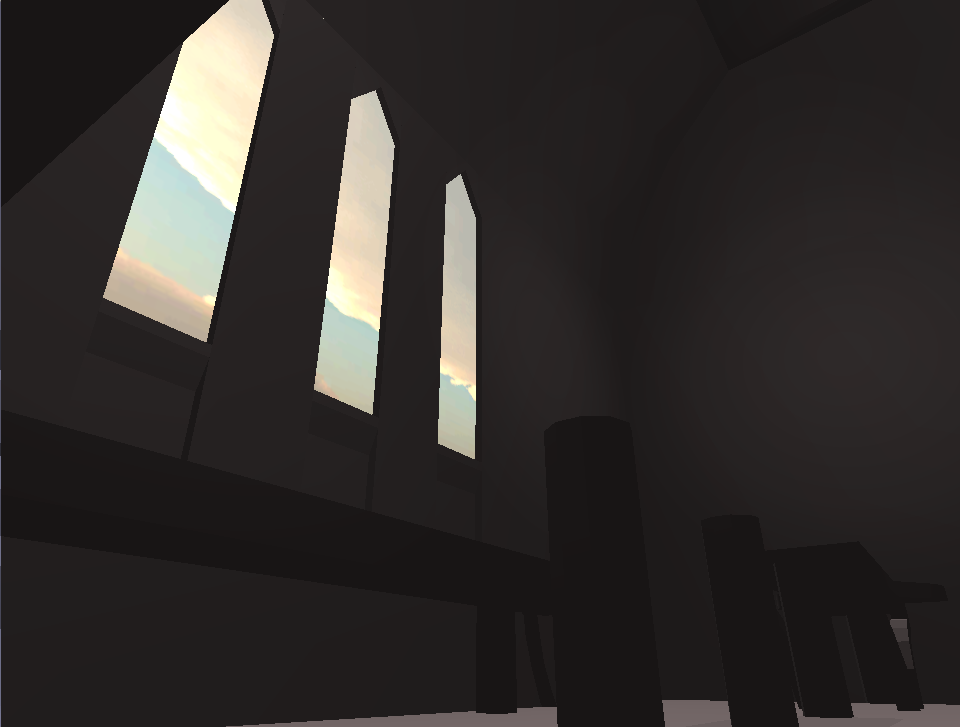
Strong centres and the void are shown with similar elements of the level. Strong centres is shown visually throughout the level with statues and particularly the boss in the boss room, which acts as a strong centre both visually and in terms of gameplay. The boss isn’t quite in the middle of the room, but rather towards the end (though he still looks fairly centred). However, everything leads up to him, and he looks giant and powerful, which certainly makes that centre a strong one. The void is shown through the large scale of the rooms, with high ceilings that make there appear to be a void above the player, as well as the emptiness of the end boss room. The boss room is very empty at the opening, but in towards the end of the room, the boss is visible and surrounded by pillars. The ceiling of this room is also very high, and there is a skylight window in order to make the height of the room feel even larger. The void in the rest of the room emphasizes the importance of the boss, and is intended to make the player feel very small in such a significant place.
The third property, boundaries, is shown very clearly in the level. The player must fulfil certain conditions in order to get to the next room, which shows clear boundaries of the game. From the middle room in the temple, the player has to place a block, using magnetism, onto the appropriate statue’s hands (or lap), in order to open the door to the corresponding room. There is a positive statue, shown in red, with a corresponding positive room, and a negative statue, shown in blue, with a corresponding negative room. Once both rooms have been completed, the boss room opens up to the player. These boundaries keep the player from going ahead to fight the boss until they have completed all the puzzles in the temple.

Middle Room - Plus Statue with Block
The fourth property, alternating repetition, is shown both through alternating between positive and negative elements, and through the alternation between puzzles and platforming which is apparent in gameplay.
The fifth property, positive space, is shown through the way the background and foreground are laid out in the level. In the background, the player sees things through the windows such as the skybox, as well as some statues and other background elements in some areas which complement each other and add to the overall aesthetic of the level. Statues also act as foreground elements in some areas, such as the courtyard where there is a large statue that is supposed to be placed in front of the doorway leading to the next room – though this room accidently got flipped when being put into Unity, so that it was placed at the far end of the room instead.
Plus Puzzle Room
Good shape, local symmetries, deep interlock and ambiguity, contrast, echoes, and non-separateness are all shown similarly in the level through the use of the positive and negative magnetic theme. The level is very symmetrical because one half is dedicated to a positive room and puzzle, and the other half is a negative room and puzzle where the room itself is symmetrical to the positive side. Good shape also reflects this idea of symmetry, because all shapes were made to harmonize with the level’s symmetry. Similarly, deep interlock and ambiguity are shown with positive versus negative, since positive cannot exist without negative, and vice versa. Each side defines the other. Contrast is also shown through positive versus negative, which is visually shown through their colours (with positive being red and negative being blue tint), as well as the side of the temple they are on. Echoes are shown in the same way as repetition – for instance, the same statue is shown in multiple rooms but in different poses and colours. Finally, non-separateness is shown through everything being well-connected within the level, through the echoing of statues, the tying in of positive and negative, and the general flow of the level.

Minus Puzzle Room
Gradients and roughness will be shown throughout the level by making the level seem less natural the further the player ventures through rooms. Since the level begins with the courtyard, everything there looks more natural, with trees scattered, and moss growing on statues. In the middle of the level, everything appears to be more made of rock, and more manmade, though still appears ancient and plausible. However, at the very end, the boss room is far less natural considering that the boss itself is partially composed of metal, and is a half robotic sort of creature. In this way, the player could feel themselves getting further and further from nature throughout the level. Roughness is shown through similar ideas – for instance, the statue in the courtyard look slightly overgrown, as they are covered in moss.

Courtyard
Lastly, simplicity and inner calm are shown through the balance and simple mechanics of the game. The player can move around, jump, and use positive or negative magnetic powers, and that is the whole premise of the game. This level reflects this simplicity since the main goal is to navigate using magnetism.
All in all, this level may be fairly short, but it definitely reflects Alexander’s fifteen properties of living structures both visually, and through gameplay.

No comments:
Post a Comment