Tuesday, April 10, 2012

Punishment in games - a crutch, or an effective means of motivation?

Punishment in games is exactly what it sounds like to any gamer – negative reinforcement in order to show the player what they did is wrong, or in order to add challenge to the game. With this said, there can certainly be other reasons for punishment, but this is a general definition. Now, I had always thought that punishment in games was a sort of crutch that game developers relied on in order to show the player the ropes and challenge them, but I always thought that there had to be a better way to do those things than punishing the player – it’s just easier to rely on punishment, since a working alternative would take so much creativity. After all, negative reinforcement in the real world generally is frowned upon in comparison to positive reinforcement, because positive reinforcement typically works better for human beings in general. However, a comment that one of my friends (a gamer, not a game developer, mind you) made about his latest favourite game inspired me to write this blog post this week, because he said words I never thought I’d hear: “I love the punishment in this game.”

The game my friend was referring to was Dark Souls – but how could the punishment in the game be so memorable and so positive in the eyes of a player? Even when punishment works in a game, I always thought that if the player consciously realized that the game was very punishing, then it would be less enjoyable. This game proved me wrong.


The player collecting their souls in Dark Souls

 
Now what is it about the punishment in Dark Souls that makes it enjoyable? Just to get this out there, I haven’t played the game – yet – though now I want to. However, I’ve seen my friend play it, and so I know a bit about how the game works. Essentially, the heavy punishment in the game is that all of the experience, or “souls”, the player collects from the last save point they visited can be lost as soon as they die. This means that the player can go through a level, collecting plenty of experience along the way, but die at the hands of the boss and lose all experience they accumulated along the way. So I asked, why is this not frustrating? How could this be a positive thing. My friend answered this for me: the lost souls can be retrieved if the player can reach them after dying without dying again along the way. In this way, the player feels that despite being punished, they have the ability to earn back what they’ve lost. On top of this, the player will likely feel that if he or she dies along the way and loses the collected souls for good, then it was a well-deserved punishment. Because of this, I realized the game Dark Souls in particular uses punishment so well that lack of punishment actually becomes a great reward. This made me then question – what is it that makes punishment work or fail in other games?

I thought of games I have personally played, and remembered different ways I recall being punished in a few of them. Unfortunately, most memories of punishment are negative ones, but I discovered some commonalities between the negative punishments. The first common negative punishment I can think of is the notorious game over screen. Sure, sometimes this is appears to be the best option in order to keep some challenge in the game (after all, a player shouldn’t be able to keep progressing after they die), but one particular type of game over screen is a little too negative for my taste. I am referring to the concept that if the player dies, they lose all progress from their last save. The harshness of this punishment varies depending on where and when the player can save. For instance, if the player can only save at certain save points, and these save points are very spread out, this punishment can be very frustrating. Another similar punishment that I am not a huge fan of is the way that the Pokemon series punishes players. If the player’s entire party faints in a battle, the player “blacks out”, teleports to the last Pokemon Center they were at, and loses a good chunk of their money. I see this as being far better than the lose-all-progress game over screen, but still can be frustrating to the player. But what do these two punishments have in common? The player may be tempted to just turn off the game after being punished in these ways. I have been victim to that mindset as well – if I hit a game over screen and lose a whole ton of progress I’ve made, I often get so upset that I turn off the game and don’t want to play it again for a while. Even in Pokemon, though the player doesn’t lose all progress, there is less incentive to keep going after fainting than there is to turn off the game and try again – though at least, I’d be more likely to try again after being punished by Pokemon than if I was punished by a game over screen. It seems that the makers of Pokemon realized that their punishment was too harsh in the earlier games, since the player would lose half of their money if they blacked out, but this amount was adjusted in later games to be far less if the player had accumulated plenty of cash over the course of the game.
Blacking out in Pokemon Diamond/Pearl


Another punishment that stood clearly in my mind was completely different from the previous two mentioned, but had a great impact on my memory though I haven’t played the game for a while. In The Legend of Zelda: Link’s Awakening, the creators stuck in a really obscure punishment based on morality. I am referring to the fact that if players are sneaky enough to manage to steal from the shop in the game, they are punished for the rest of the game through shaming. I tried this out of curiosity the first time I played the game. I managed to steal an expensive item from the shop, and when I returned, the shop owner killed me. I thought that was it in terms of punishment. I saved the game and kept going. However, everyone in the game from that point on kept calling me “THIEF” instead of the name I picked at the beginning of the game. At first, I ignored it, even laughed a little, but I realized it actually upset me when I saw cutscenes that were supposed to be serious and touching, and the other characters still kept calling me “THIEF”. I actually felt far more ashamed of stealing that one item than I ever thought I would be, because that took away from my experience for the rest of the game. On one hand, this punishment was extremely effective because I felt very ashamed, just as the makers of the game had intended. But on the other hand, I despised this punishment because that one mistake haunted me for the rest of the game. A little bit of curiosity ended up making me really resentful. Thus, I’ll always remember this punishment very negatively in my mind.


So, what really makes punishments bad, and what makes them good? There are many answers to this question, but I’ve personally discovered a few based on my own experience, and the experience of my friend who played Dark Souls. Any punishment in a game that makes it so that the player wants to turn off the game, or has no incentive to keep playing, is clearly bad. Also, any punishment that haunts the player for the entirety of the game without fair warning is also bad, because if the player really dislikes the punishment, they may feel that all of their progress up to that point was wasted if they don’t want to continue with the lingering punishment hanging over their heads. However, punishments that the player has a fair opportunity to recover from can be positive, such as in the case of Dark Souls, or even in a game like Minecraft where the dying player loses their items, but can recover them if they make it back to the spot that they died. Because of this, I learned that punishment isn’t only not always a bad thing, but it can be a very good thing in enriching a game experience for players.

Wednesday, April 4, 2012

Ratrocity Design


This week, my group designed and made a unity game and a paper prototype out of a very obscure concept. The theme used was “game where you play a life support machine in a hospital but during the night you turn into a diseased rat”. We called the game Ratrocity. We thought this idea had potential to be a sort of balancing game – as a life support machine during the day, you are trying to heal patients to keep them from dying. As a diseased rat at night, you are trying to spread your disease to the patients to make their health go down so that they don’t heal enough to leave the hospital. In this way, the hospital will make the most money since patients will stay under its care for the greatest possible amount of time if they can’t die or heal enough to leave.


Mechanics

The mechanics of this game are fairly simple. There are six patients lying in bed on the screen, and the player must click a patient in order to give them health during the day while they are dying, or inflict harm at night while they are healing. The goal is to keep all patients alive and in the hospital as long as possible. The player gets points based on the amount of time that they can keep patients in the hospital. If all patients die or are fully healed, the game is over. The player must quickly and repeatedly click patients to have a great impact on their health. The player must move the mouse from patient to patient in order to keep them all at moderate health.

Aesthetics

                The art and sounds of the game are also not very elaborate. The general look of the game is friendly, with a smiling sun and moon representing day and night and other cheerful looking elements, but with an ugly rat at night to contrast the cheerfulness of the rest of the images. This could represent the hospital itself in the sense that it disguises itself as being good and working to heal patients, when meanwhile patients are harmed at night in order to keep them in the hospital – meaning, the ugly side of the hospital comes out at night.  

                The patients in the game are represented by hospital beds with a simple red health bar above which shrinks and grows. There is a sun or moon shown at the top right corner of the screen to represent day and night, and the screen also changes from bright (day) to dark (night) to really stress the change in time. The score is shown at the top left corner of the screen, and the player is represented by a life support machine during the day, and an ugly rat at night.

                The game does not have any music because the sounds used provide enough atmosphere that we thought any music might be distracting. As background noise, there is the beep of the life support machine going at all times. Every now and then at night, the rat will squeal. During the transition from day to night, the sound of crickets plays. During the transition from night to day, the sound of a rooster plays. These sounds also help to stress the change in time along with the change in colors and the sun or moon image at the side. Altogether, the sounds are simple, but they serve their purpose.

Dynamics

                The dynamics of the game are all shown through player choice, and how the player personally chooses to play the game. For one, the player has to make the decision between trying to keep all patients alive and in the hospital, or focusing on a select few. Ideally, keeping all patients alive would earn the player more points than just having some of them alive, though currently the score of the game is solely determined by the amount of time the player lasts without losing all patients. However, if the score was determined by both time and the number of patients in the hospital, this would give the player the choice of whether to take the riskier route in trying to keep all patients in the hospital as long as possible to earn the most points, or the safer route in trying to keep a few patients at moderate health while letting the others die or heal. The first option would be risky because it is more difficult to keep track of more patients. 

                Another interesting dynamic that is affected by player choice is the idea that since the time shifts between day and night with little to no warning, the player must make sure that they don’t heal or injure the patient too much. This is because if the player were hurting a patient with the rat at night and then the time switched to day, the patient would then begin to lose health on their own, and then the player would have to frantically take care of that patient to keep them from dying. This means that the player has to be careful to keep patients at a very balanced health rather than trying to do a whole lot of damage or healing at once.


                All in all, it was very interesting to make a game from such a strange and random concept.  To improve Ratrocity, we would have to balance the mechanics more in order to make it more difficult in lower levels (so the player can’t get by with doing nothing) and easier in higher levels (so it is actually possible to beat later levels). However, the game is still fully playable, and could actually be a lot of fun if we’d put a lot of time into balancing.

Tuesday, March 27, 2012

Don’t Die, Single Player Games!


Lately, game developers seem to be turning towards making games more “social” than they were in the past. The final talk at MIGS 2011, “When Socialization Meets High-Definition Gaming” by Yves Guillemot, really made me think about the direction that modern games are turning towards.


Now, obviously this is not true for all games nowadays, but more and more game developers seem to be stressing making games that would normally be single-player into games that are more reliant on multiplayer aspects and an internet connection. I have no problem with games that are intended to be multiplayer, because these games work, and players enjoy them knowing from the beginning that they will have to play these games on multiplayer mode to get the highest level of enjoyment from them. I also have no problem with single player games that give players the option of playing on a multiplayer mode in order to enrich the experience, while remaining mostly separate from the single-player mode from the game, such as a single player game where you could break away from the main game to fight another player, just for fun. Maybe players could even get minor bonuses from multi-player mode. However, I can’t stand games that disguise themselves as single-player, but they were built so that players cannot completely enjoy the game without playing with others. I believe that games should NOT be designed this way, because many gamers have their own reasons why they cannot or do not want to play multiplayers. Because of this, these gamers end up being frustrated with these “single-player” games that still require multiplayer for some things. 


One reason why I believe this is a bad direction for games to turn is that some gamers do not have friends that will play these particular games with them. In the MIGS talk I mentioned above, there were examples of where games could turn in the future, such as requiring two friends to connect to each other and help each other out in a game, such as giving each other crucial weapons, etc. I distinctly remember that when someone in the crowd asked, “What if a player does not have friends to play with?” the response was, “Then go out and make some friends.” I remember when I was young, I had no friends to play games with. Why? None of my friends were gamers. Therefore, I could never play games that required me to play with friends, and I became a solo gamer. I remember finding it frustrating playing Pokemon when I was younger, because even though I loved (and still love) the games, one of the major goals, “catching them all”, would be impossible to complete without having a friend to trade with. And even now that I have plenty of friends that play games, it can STILL be difficult to find friends that play a specific game that I want to play. Thus, I think it’s a bad idea to push players into “connecting with their friends” in order to finish their single-player games because this excludes many gamers from the target market. I feel that this is a design tactic that is used to get gamers to get their friends into the game, but this is a very cheap tactic, and could hurt more than it could help.

Another problem with this is the fact that game developers seem to often assume that since their technology is evolving, every gamer will have the best, most up-to-date technology. In this scenario, I am thinking about the internet. If a game is “single-player”, gamers that do not have a stable internet connection, don’t have wifi, or don’t have internet at all will probably assume that they are fully capable of playing this game. However, if the game cannot be fully completed without an internet connection, these gamers will be a little bit peeved. Using the internet to enrich game experiences can be a very great thing, but single-player games should not REQUIRE the internet in order to function. After all, they’re SINGLE-player, so internet should not logically be a requirement in most cases. Once again, designing games in this way feels like discrimination against certain types of gamers – in this case, gamers without access to the internet. If a single-player game requires the internet, it should have a good reason, otherwise it should have a no-internet option. For instance, games like Minecraft are enriched by an internet connection, and obviously multiplayer mode requires the internet, but single-player can still be played without the internet, with only minor differences. I believe that game designers would do well to follow this idea – making games playable with or without the internet.


Finally, we can’t forget that some players simply don’t like to play games with others. I know because I personally prefer playing games by myself most of the time. It seems that many game developers nowadays assume that since more and more players are getting into multiplayer games, the solo gamers have gone extinct. This is a very foolish assumption. As game developers, we should make games that satisfy these types of gamers as well rather than ignoring them entirely. The best option would be to make single-player games have an OPTION to have multiplayer, but the game can be played through to its fullest without using this option. In this way, the greatest variety of gamers will be satisfied.

All in all, I believe that single-player games should not feel like half an experience without the internet or friends to play with. Sure, single-player games can be enriched by multiplayer aspects, but they should still feel complete without them if they truly are single-player games. I believe going in the direction of making all single-player games more reliant on friends and the internet is a bad design decision. If we, as game developers and game designers, still want to give our players the richest experience possible, we shouldn’t make them feel forced into playing in a particular way. If we give them the option rather than pushing them into playing with friends, I believe games will move in a more positive direction in the future.

Monday, March 19, 2012

Maegnos Level in Unity


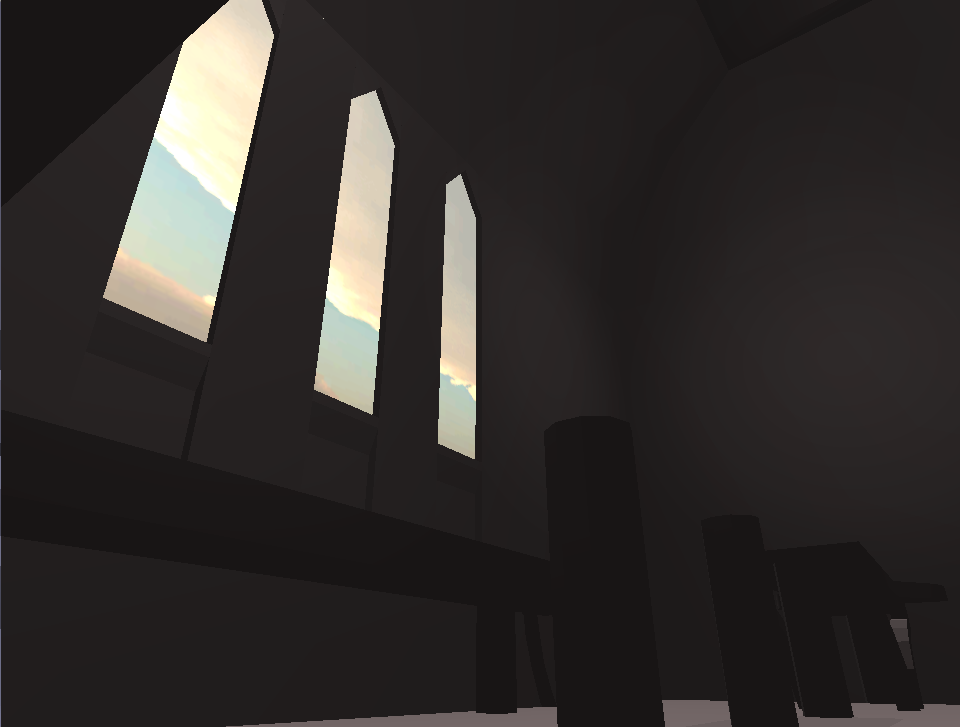
Last week, I put together the rooms composing the level in my group’s game, Maegnos, in order to include Alexander’s 15 properties of living structures. I personally built the boss room of our game and put that together with the rooms that the rest of my team made, and made the game work in its most basic form in Unity. With all rooms combined, the level exhibits all 15 properties of living structures.

The first property, levels of scale, is shown in this level via the player’s progression through the level. In this level, and the game as a whole, the player must solve puzzles, which are the short term goals, in order to make it through rooms, which are the mid-term goals, in order to eventually reach the boss room and defeat the boss, which is the end term goal. In this way, the player can feel that the goals of the game build up on each other in order to reach the end.

Boss Room

Strong centres and the void are shown with similar elements of the level. Strong centres is shown visually throughout the level with statues and particularly the boss in the boss room, which acts as a strong centre both visually and in terms of gameplay. The boss isn’t quite in the middle of the room, but rather towards the end (though he still looks fairly centred). However, everything leads up to him, and he looks giant and powerful, which certainly makes that centre a strong one. The void is shown through the large scale of the rooms, with high ceilings that make there appear to be a void above the player, as well as the emptiness of the end boss room. The boss room is very empty at the opening, but in towards the end of the room, the boss is visible and surrounded by pillars. The ceiling of this room is also very high, and there is a skylight window in order to make the height of the room feel even larger. The void in the rest of the room emphasizes the importance of the boss, and is intended to make the player feel very small in such a significant place.

The third property, boundaries, is shown very clearly in the level. The player must fulfil certain conditions in order to get to the next room, which shows clear boundaries of the game. From the middle room in the temple, the player has to place a block, using magnetism, onto the appropriate statue’s hands (or lap), in order to open the door to the corresponding room. There is a positive statue, shown in red, with a corresponding positive room, and a negative statue, shown in blue, with a corresponding negative room. Once both rooms have been completed, the boss room opens up to the player. These boundaries keep the player from going ahead to fight the boss until they have completed all the puzzles in the temple.

Middle Room - Plus Statue with Block

The fourth property, alternating repetition, is shown both through alternating between positive and negative elements, and through the alternation between puzzles and platforming which is apparent in gameplay.

The fifth property, positive space, is shown through the way the background and foreground are laid out in the level. In the background, the player sees things through the windows such as the skybox, as well as some statues and other background elements in some areas which complement each other and add to the overall aesthetic of the level. Statues also act as foreground elements in some areas, such as the courtyard where there is a large statue that is supposed to be placed in front of the doorway leading to the next room – though this room accidently got flipped when being put into Unity, so that it was placed at the far end of the room instead.

Plus Puzzle Room

Good shape, local symmetries, deep interlock and ambiguity, contrast, echoes, and non-separateness are all shown similarly in the level through the use of the positive and negative magnetic theme. The level is very symmetrical because one half is dedicated to a positive room and puzzle, and the other half is a negative room and puzzle where the room itself is symmetrical to the positive side. Good shape also reflects this idea of symmetry, because all shapes were made to harmonize with the level’s symmetry. Similarly, deep interlock and ambiguity are shown with positive versus negative, since positive cannot exist without negative, and vice versa. Each side defines the other. Contrast is also shown through positive versus negative, which is visually shown through their colours (with positive being red and negative being blue tint), as well as the side of the temple they are on. Echoes are shown in the same way as repetition – for instance, the same statue is shown in multiple rooms but in different poses and colours. Finally, non-separateness is shown through everything being well-connected within the level, through the echoing of statues, the tying in of positive and negative, and the general flow of the level.

 Minus Puzzle Room

Gradients and roughness will be shown throughout the level by making the level seem less natural the further the player ventures through rooms. Since the level begins with the courtyard, everything there looks more natural, with trees scattered, and moss growing on statues. In the middle of the level, everything appears to be more made of rock, and more manmade, though still appears ancient and plausible. However, at the very end, the boss room is far less natural considering that the boss itself is partially composed of metal, and is a half robotic sort of creature. In this way, the player could feel themselves getting further and further from nature throughout the level. Roughness is shown through similar ideas – for instance, the statue in the courtyard look slightly overgrown, as they are covered in moss.

Courtyard

Lastly, simplicity and inner calm are shown through the balance and simple mechanics of the game. The player can move around, jump, and use positive or negative magnetic powers, and that is the whole premise of the game. This level reflects this simplicity since the main goal is to navigate using magnetism.

All in all, this level may be fairly short, but it definitely reflects Alexander’s fifteen properties of living structures both visually, and through gameplay.

Thursday, March 8, 2012

Non-Interactive Cutscenes


Nowadays, many game designers and even gamers have the strong belief that cutscenes are unnecessary, and the future of games will be to “cut” cutscenes out of games entirely – especially non-interactive cutscenes. I have heard numerous times that non-interactive cutscenes take away from gameplay, and are not immersive enough for players when gameplay could be used instead. I have heard that these types of non-interactive cinematic experiences should be left for movies, since movies can create these kinds of experiences better than games can. In my opinion, this is a ridiculous idea. I have always loved great cutscenes, especially non-interactive ones, and here are some reasons why.

 Kingdom Hearts 2

First of all, having non-interactive cutscenes does NOT mean that the gameplay will be bad in any way. Some gamers and game developers seem to think that cutscenes will take away from gameplay, but this is completely illogical. If gameplay is good, it will be good regardless of whatever else is added to the game. In addition, we don’t need to leave amazing cinematic experiences to movie makers, because cutscenes deserve their place in games. Just because movies are better at showing a full story in a cinematic way doesn’t mean that games can’t use cinematic cutscenes as a creative aid in telling the story of the game. Game developers should not limit themselves with rules of what does or does not belong in games if there are players that still enjoy these things.

Also, I would like to argue against the point that movies create non-interactive cinematic experiences far better than games ever could. I personally find that I get very drawn into non-interactive cutscenes in games because the gameplay of the game gets me very attached to the characters since I control the main character, and so I feel like I am personally interacting with all the characters rather than just watching them. This makes the story feel more personal, and so when cutscenes come along, I am more drawn into whatever happens than I am while watching a movie. In this way, the gameplay serves to set up the cutscene to have a greater emotional connection with the player through interactions with characters, so when the cutscene actually happens, it has the potential to be extremely moving. Now, I know that many players may not agree with me, but this is the greatest reason why I love cutscenes in games – I have far greater potential to fall in love with the characters through a game, so the cutscene, despite being non-interactive, has the potential to be far more moving than any movie.

 Persona 4

Another reason why I love non-interactive cutscenes in games is because if the cutscene and story of the game are really good, they can feel like a reward after a big gameplay challenge, such as fighting a boss. I have always loved beating bosses in cutscene-heavy games not just because of the accomplishment involved in taken down a tough enemy, but because I know a cutscene is likely coming up which will advance the story – and I love being able to sit back and relax after a lot of difficult gameplay. If the cutscenes in the game are really well done, to me, they are the best way of showing a major story event. With that said, cutscenes should not be the only means of progressing the story. The story should progress through gameplay as well, or else the gameplay will not add anything to the cutscene to make it more effective. However, cutscenes are still great for showing really important or dramatic changes in story that gameplay just can’t accomplish as well. The non-interactivity of the cutscene is also important to me because if the cutscene is showing a really major plot event, in most cases, I do not want anything to distract me from what is happening. I would rather sit back and watch with my full attention rather than mess around and see how I can interact with what is happening.

 Final Fantasy X

Lastly, fantastic cutscenes make a game far more memorable to me. I’m not just talking about beautiful graphics and sound, but actually showing great plot events and really dramatic or emotional moments in cutscenes can really get players to remember the game. A game with good gameplay but no amazing cutscenes will be fun for a while, but in many cases, I’ll eventually forget it. However, games with excellent cutscenes that show an amazing story (along with the gameplay, of course) can stay on the surface of my mind for weeks or even months. I have had games with great cutscenes showing pieces of even greater stories haunt my dreams after playing them, in the best way possible. These are often the games that I want to replay the most, because I want to experience them again. And with great cutscenes and a great story, a game truly is an “experience” rather than just a game.

In the end, cutscenes are not everything. A game developer cannot make a game with gorgeous cutscenes and crummy gameplay and expect it to be successful. However, a game with an excellent story and cutscenes that show the story brilliantly can have so much more to offer if the game developer(s) know what they’re doing. Gamers and game developers need to stop trashing cutscenes, especially non-interactive cutscenes, and open their eyes to the fact that interactivity isn’t everything.  Cutscenes can add so much to a game if they are done right.

I am an avid gamer and game developer, and I love well-made, non-interactive cutscenes.