Tuesday, March 27, 2012

Don’t Die, Single Player Games!


Lately, game developers seem to be turning towards making games more “social” than they were in the past. The final talk at MIGS 2011, “When Socialization Meets High-Definition Gaming” by Yves Guillemot, really made me think about the direction that modern games are turning towards.


Now, obviously this is not true for all games nowadays, but more and more game developers seem to be stressing making games that would normally be single-player into games that are more reliant on multiplayer aspects and an internet connection. I have no problem with games that are intended to be multiplayer, because these games work, and players enjoy them knowing from the beginning that they will have to play these games on multiplayer mode to get the highest level of enjoyment from them. I also have no problem with single player games that give players the option of playing on a multiplayer mode in order to enrich the experience, while remaining mostly separate from the single-player mode from the game, such as a single player game where you could break away from the main game to fight another player, just for fun. Maybe players could even get minor bonuses from multi-player mode. However, I can’t stand games that disguise themselves as single-player, but they were built so that players cannot completely enjoy the game without playing with others. I believe that games should NOT be designed this way, because many gamers have their own reasons why they cannot or do not want to play multiplayers. Because of this, these gamers end up being frustrated with these “single-player” games that still require multiplayer for some things. 


One reason why I believe this is a bad direction for games to turn is that some gamers do not have friends that will play these particular games with them. In the MIGS talk I mentioned above, there were examples of where games could turn in the future, such as requiring two friends to connect to each other and help each other out in a game, such as giving each other crucial weapons, etc. I distinctly remember that when someone in the crowd asked, “What if a player does not have friends to play with?” the response was, “Then go out and make some friends.” I remember when I was young, I had no friends to play games with. Why? None of my friends were gamers. Therefore, I could never play games that required me to play with friends, and I became a solo gamer. I remember finding it frustrating playing Pokemon when I was younger, because even though I loved (and still love) the games, one of the major goals, “catching them all”, would be impossible to complete without having a friend to trade with. And even now that I have plenty of friends that play games, it can STILL be difficult to find friends that play a specific game that I want to play. Thus, I think it’s a bad idea to push players into “connecting with their friends” in order to finish their single-player games because this excludes many gamers from the target market. I feel that this is a design tactic that is used to get gamers to get their friends into the game, but this is a very cheap tactic, and could hurt more than it could help.

Another problem with this is the fact that game developers seem to often assume that since their technology is evolving, every gamer will have the best, most up-to-date technology. In this scenario, I am thinking about the internet. If a game is “single-player”, gamers that do not have a stable internet connection, don’t have wifi, or don’t have internet at all will probably assume that they are fully capable of playing this game. However, if the game cannot be fully completed without an internet connection, these gamers will be a little bit peeved. Using the internet to enrich game experiences can be a very great thing, but single-player games should not REQUIRE the internet in order to function. After all, they’re SINGLE-player, so internet should not logically be a requirement in most cases. Once again, designing games in this way feels like discrimination against certain types of gamers – in this case, gamers without access to the internet. If a single-player game requires the internet, it should have a good reason, otherwise it should have a no-internet option. For instance, games like Minecraft are enriched by an internet connection, and obviously multiplayer mode requires the internet, but single-player can still be played without the internet, with only minor differences. I believe that game designers would do well to follow this idea – making games playable with or without the internet.


Finally, we can’t forget that some players simply don’t like to play games with others. I know because I personally prefer playing games by myself most of the time. It seems that many game developers nowadays assume that since more and more players are getting into multiplayer games, the solo gamers have gone extinct. This is a very foolish assumption. As game developers, we should make games that satisfy these types of gamers as well rather than ignoring them entirely. The best option would be to make single-player games have an OPTION to have multiplayer, but the game can be played through to its fullest without using this option. In this way, the greatest variety of gamers will be satisfied.

All in all, I believe that single-player games should not feel like half an experience without the internet or friends to play with. Sure, single-player games can be enriched by multiplayer aspects, but they should still feel complete without them if they truly are single-player games. I believe going in the direction of making all single-player games more reliant on friends and the internet is a bad design decision. If we, as game developers and game designers, still want to give our players the richest experience possible, we shouldn’t make them feel forced into playing in a particular way. If we give them the option rather than pushing them into playing with friends, I believe games will move in a more positive direction in the future.

Monday, March 19, 2012

Maegnos Level in Unity


Last week, I put together the rooms composing the level in my group’s game, Maegnos, in order to include Alexander’s 15 properties of living structures. I personally built the boss room of our game and put that together with the rooms that the rest of my team made, and made the game work in its most basic form in Unity. With all rooms combined, the level exhibits all 15 properties of living structures.

The first property, levels of scale, is shown in this level via the player’s progression through the level. In this level, and the game as a whole, the player must solve puzzles, which are the short term goals, in order to make it through rooms, which are the mid-term goals, in order to eventually reach the boss room and defeat the boss, which is the end term goal. In this way, the player can feel that the goals of the game build up on each other in order to reach the end.

Boss Room

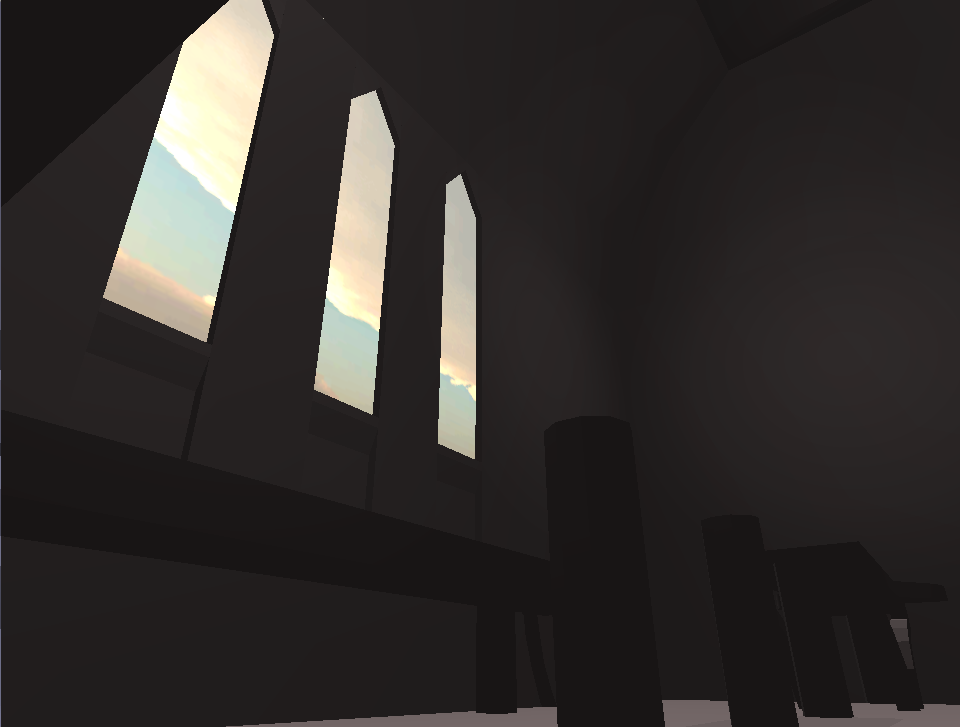
Strong centres and the void are shown with similar elements of the level. Strong centres is shown visually throughout the level with statues and particularly the boss in the boss room, which acts as a strong centre both visually and in terms of gameplay. The boss isn’t quite in the middle of the room, but rather towards the end (though he still looks fairly centred). However, everything leads up to him, and he looks giant and powerful, which certainly makes that centre a strong one. The void is shown through the large scale of the rooms, with high ceilings that make there appear to be a void above the player, as well as the emptiness of the end boss room. The boss room is very empty at the opening, but in towards the end of the room, the boss is visible and surrounded by pillars. The ceiling of this room is also very high, and there is a skylight window in order to make the height of the room feel even larger. The void in the rest of the room emphasizes the importance of the boss, and is intended to make the player feel very small in such a significant place.

The third property, boundaries, is shown very clearly in the level. The player must fulfil certain conditions in order to get to the next room, which shows clear boundaries of the game. From the middle room in the temple, the player has to place a block, using magnetism, onto the appropriate statue’s hands (or lap), in order to open the door to the corresponding room. There is a positive statue, shown in red, with a corresponding positive room, and a negative statue, shown in blue, with a corresponding negative room. Once both rooms have been completed, the boss room opens up to the player. These boundaries keep the player from going ahead to fight the boss until they have completed all the puzzles in the temple.

Middle Room - Plus Statue with Block

The fourth property, alternating repetition, is shown both through alternating between positive and negative elements, and through the alternation between puzzles and platforming which is apparent in gameplay.

The fifth property, positive space, is shown through the way the background and foreground are laid out in the level. In the background, the player sees things through the windows such as the skybox, as well as some statues and other background elements in some areas which complement each other and add to the overall aesthetic of the level. Statues also act as foreground elements in some areas, such as the courtyard where there is a large statue that is supposed to be placed in front of the doorway leading to the next room – though this room accidently got flipped when being put into Unity, so that it was placed at the far end of the room instead.

Plus Puzzle Room

Good shape, local symmetries, deep interlock and ambiguity, contrast, echoes, and non-separateness are all shown similarly in the level through the use of the positive and negative magnetic theme. The level is very symmetrical because one half is dedicated to a positive room and puzzle, and the other half is a negative room and puzzle where the room itself is symmetrical to the positive side. Good shape also reflects this idea of symmetry, because all shapes were made to harmonize with the level’s symmetry. Similarly, deep interlock and ambiguity are shown with positive versus negative, since positive cannot exist without negative, and vice versa. Each side defines the other. Contrast is also shown through positive versus negative, which is visually shown through their colours (with positive being red and negative being blue tint), as well as the side of the temple they are on. Echoes are shown in the same way as repetition – for instance, the same statue is shown in multiple rooms but in different poses and colours. Finally, non-separateness is shown through everything being well-connected within the level, through the echoing of statues, the tying in of positive and negative, and the general flow of the level.

 Minus Puzzle Room

Gradients and roughness will be shown throughout the level by making the level seem less natural the further the player ventures through rooms. Since the level begins with the courtyard, everything there looks more natural, with trees scattered, and moss growing on statues. In the middle of the level, everything appears to be more made of rock, and more manmade, though still appears ancient and plausible. However, at the very end, the boss room is far less natural considering that the boss itself is partially composed of metal, and is a half robotic sort of creature. In this way, the player could feel themselves getting further and further from nature throughout the level. Roughness is shown through similar ideas – for instance, the statue in the courtyard look slightly overgrown, as they are covered in moss.

Courtyard

Lastly, simplicity and inner calm are shown through the balance and simple mechanics of the game. The player can move around, jump, and use positive or negative magnetic powers, and that is the whole premise of the game. This level reflects this simplicity since the main goal is to navigate using magnetism.

All in all, this level may be fairly short, but it definitely reflects Alexander’s fifteen properties of living structures both visually, and through gameplay.

Thursday, March 8, 2012

Non-Interactive Cutscenes


Nowadays, many game designers and even gamers have the strong belief that cutscenes are unnecessary, and the future of games will be to “cut” cutscenes out of games entirely – especially non-interactive cutscenes. I have heard numerous times that non-interactive cutscenes take away from gameplay, and are not immersive enough for players when gameplay could be used instead. I have heard that these types of non-interactive cinematic experiences should be left for movies, since movies can create these kinds of experiences better than games can. In my opinion, this is a ridiculous idea. I have always loved great cutscenes, especially non-interactive ones, and here are some reasons why.

 Kingdom Hearts 2

First of all, having non-interactive cutscenes does NOT mean that the gameplay will be bad in any way. Some gamers and game developers seem to think that cutscenes will take away from gameplay, but this is completely illogical. If gameplay is good, it will be good regardless of whatever else is added to the game. In addition, we don’t need to leave amazing cinematic experiences to movie makers, because cutscenes deserve their place in games. Just because movies are better at showing a full story in a cinematic way doesn’t mean that games can’t use cinematic cutscenes as a creative aid in telling the story of the game. Game developers should not limit themselves with rules of what does or does not belong in games if there are players that still enjoy these things.

Also, I would like to argue against the point that movies create non-interactive cinematic experiences far better than games ever could. I personally find that I get very drawn into non-interactive cutscenes in games because the gameplay of the game gets me very attached to the characters since I control the main character, and so I feel like I am personally interacting with all the characters rather than just watching them. This makes the story feel more personal, and so when cutscenes come along, I am more drawn into whatever happens than I am while watching a movie. In this way, the gameplay serves to set up the cutscene to have a greater emotional connection with the player through interactions with characters, so when the cutscene actually happens, it has the potential to be extremely moving. Now, I know that many players may not agree with me, but this is the greatest reason why I love cutscenes in games – I have far greater potential to fall in love with the characters through a game, so the cutscene, despite being non-interactive, has the potential to be far more moving than any movie.

 Persona 4

Another reason why I love non-interactive cutscenes in games is because if the cutscene and story of the game are really good, they can feel like a reward after a big gameplay challenge, such as fighting a boss. I have always loved beating bosses in cutscene-heavy games not just because of the accomplishment involved in taken down a tough enemy, but because I know a cutscene is likely coming up which will advance the story – and I love being able to sit back and relax after a lot of difficult gameplay. If the cutscenes in the game are really well done, to me, they are the best way of showing a major story event. With that said, cutscenes should not be the only means of progressing the story. The story should progress through gameplay as well, or else the gameplay will not add anything to the cutscene to make it more effective. However, cutscenes are still great for showing really important or dramatic changes in story that gameplay just can’t accomplish as well. The non-interactivity of the cutscene is also important to me because if the cutscene is showing a really major plot event, in most cases, I do not want anything to distract me from what is happening. I would rather sit back and watch with my full attention rather than mess around and see how I can interact with what is happening.

 Final Fantasy X

Lastly, fantastic cutscenes make a game far more memorable to me. I’m not just talking about beautiful graphics and sound, but actually showing great plot events and really dramatic or emotional moments in cutscenes can really get players to remember the game. A game with good gameplay but no amazing cutscenes will be fun for a while, but in many cases, I’ll eventually forget it. However, games with excellent cutscenes that show an amazing story (along with the gameplay, of course) can stay on the surface of my mind for weeks or even months. I have had games with great cutscenes showing pieces of even greater stories haunt my dreams after playing them, in the best way possible. These are often the games that I want to replay the most, because I want to experience them again. And with great cutscenes and a great story, a game truly is an “experience” rather than just a game.

In the end, cutscenes are not everything. A game developer cannot make a game with gorgeous cutscenes and crummy gameplay and expect it to be successful. However, a game with an excellent story and cutscenes that show the story brilliantly can have so much more to offer if the game developer(s) know what they’re doing. Gamers and game developers need to stop trashing cutscenes, especially non-interactive cutscenes, and open their eyes to the fact that interactivity isn’t everything.  Cutscenes can add so much to a game if they are done right.

I am an avid gamer and game developer, and I love well-made, non-interactive cutscenes.